ClimaCoupler.jl
Coupling CliMA Models
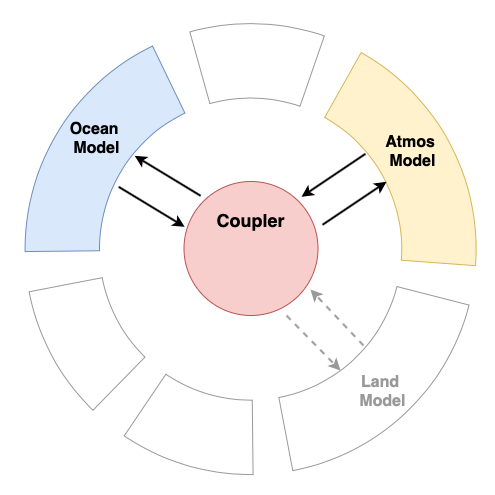
ClimaCoupler.jl provides a flexible infrastructure to connect independent component models of the Earth system (atmosphere, land, ocean, and sea ice). This is done by exchanging information at their boundaries, typically in the form of fluxes.
Key functionality of ClimaCoupler.jl includes:
- Time stepping: Coupled system time stepping control allowing for component models to use various timesteps individually.
- Flux calculation: Flux calculation between the atmosphere and each surface models utilizing SurfaceFluxes.jl.
- Information exchange: A generic interface to retrieve information from component models that is needed to compute surface fluxes, and to update component models with the resulting fluxes.
- Remapping: Remapping capabilities to support component models running on different grid discretizations and with different resolutions.
- Parallelization: High-performance computing is enabled via use of GPUs and MPI for distributed computing, using ClimaCore.jl to handle under-the-hood numerics and discretizations.
ClimaCoupler.jl is developed as part of the Climate Modeling Alliance (CliMA) project.
 |
|---|
| ClimaCoupler.jl allows for independent development of interchangeable component models. |
Package structure
ClimaCoupler.jl is organized as a set of modules, each with a distinct role in the coupling.
Coupler interface
Core modules
- Interfacer: Defines the interface for coupling component models, i.e. functions that must be extended to use a component model with ClimaCoupler.jl.
- Input: Handles parsing command-line inputs and loading configuration files, as well as verifying the validity of user-provided options.
- SimCoordinator: Coordinates execution of coupled simulations, providing
step!andrun!to advance the simulation through time. - TimeManager: Handles simulation dates and times, including callback scheduling and support for both Float64 and integer time (
ITime) types. - FieldExchanger: Provides functions required to exchange fields between the atmosphere and surface component models at each coupling timestep, building on top of the Interfacer module.
- FluxCalculator: Computes turbulent surface fluxes between the atmosphere and each surface model using SurfaceFluxes.jl.
- Checkpointer: Saves and restores simulation checkpoints, allowing long simulations to be restarted as needed.
- ConservationChecker: Logs global conservation of energy and water across the coupled system, for use with closed-system configurations (i.e. slabplanet simulations).
- Utilities: Provides shared helper functions and constants used across modules, including device setup, MPI context, and output directory management.
Provided component models
- Models: Implements simple built-in surface models (slab ocean, prescribed ocean, prescribed sea ice) for use when more sophisticated component models are not needed.
Simulation output
- SimOutput: Provides utilities for configuring diagnostics output, benchmarking analysis, and loading simulation and observational data.
- Plotting: Provides visualization tools for simulation output, including diagnostic plots, leaderboard comparisons between simulation output and observations, calibration plots, and conservation plots.
Parameter calibration
- Parameter calibration: Provides utilities for setting up model calibration experiments, including data loaders for observational data.
Extensions
In addition to the modules located in src/, ClimaCoupler.jl contains package extensions located in ext/. These primarily extend the coupling interface for particular component models, and also provide plotting utilities. Placing these pieces in extensions allows the top-level package environment of ClimaCoupler.jl to remain streamlined, while also supporting more complex setups.
The available extensions are:
ClimaCouplerClimaAtmosExt: Extends the coupler interface for ClimaAtmos.jl, implementing field exchanges, flux computation, and checkpointing for the CliMA atmosphere model.ClimaCouplerClimaLandExt: Extends the coupler interface for ClimaLand.jl, supporting both the bucket land model and the integrated land model.ClimaCouplerCMIPExt: Extends the coupler interface for CMIP-class coupled simulations, integrating Oceananigans.jl as the ocean model and ClimaSeaIce.jl as the sea ice model.ClimaCouplerMakieExt: Implements all Plotting functions using Makie.jl, CairoMakie.jl, and GeoMakie.jl. Loaded automatically when these packages are available.ClimaCouplerCMIPMakieExt: Extends the Makie plotting support to handle Oceananigans.jl fields when Oceananigans is used as the ocean component model.
Details about the component model extensions can be found in the section Models in Extensions, and details about the plotting extensions can be found in Plotting.
Documentation structure
- Running a Simulation: How to launch and configure a simulation from the command line, REPL, or as an installed package.
- Available Component Models: Describes the built-in surface models (slab ocean, prescribed ocean, prescribed sea ice) and the more complex models provided by package extensions.
- Available Simulation Types: Explains each supported
mode_nameoption (AMIP, CMIP, slabplanet variants, subseasonal) and the component models each uses. - Coupler interface: This section includes one page per module in
src/, each documenting that module's public API and functions. - Simulation output: Documentation for saving diagnostics, visualization, leaderboard comparisons against observations, and performance benchmarking.
- Examples: Walkthroughs of running specific experiments.
- Performance Tips: CPU vs GPU guidance, reference SYPD numbers, and compiler flag recommendations for short vs long runs.
- Debugging Tips: Practical tips for debugging package incompatibilities, numerical instabilities, and software errors.
- CalibrationTools: Utilities for setting up parameter calibration experiments using ERA5 observational data.
- Contributing: Guidelines for contributing to ClimaCoupler.jl.