Perfect Model Site-Level Calibration Tutorial
This tutorial demonstrates how to perform a perfect model calibration experiment using ClimaLand. In a perfect model experiment, we generate synthetic observations from our model with known parameters, then use ensemble Kalman inversion to recover those parameters. This approach allows us to evaluate the calibration method without the influence of model structural errors.
In this tutorial we will calibrate the Vcmax25 parameter using latent heat flux observations from the FLUXNET site (US-MOz).
Overview
The tutorial covers:
- Setting up a land surface model for a FLUXNET site (US-MOz)
- Creating a synthetic observation dataset
- Implementing Ensemble Kalman Inversion
- Analyzing the calibration results
Setup and Imports
Load all the necessary packages for land surface modeling, diagnostics, plotting, and ensemble methods:
using ClimaLand
using ClimaLand.Domains: Column
using ClimaLand.Canopy
using ClimaLand.Simulations
import ClimaLand.FluxnetSimulations as FluxnetSimulations
import ClimaLand.Parameters as LP
import ClimaLand.LandSimVis as LandSimVis
import ClimaDiagnostics
import EnsembleKalmanProcesses as EKP
import EnsembleKalmanProcesses.ParameterDistributions as PD
using CairoMakie
CairoMakie.activate!()
using Statistics
using Logging
import Random
using Dates
using ClimaAnalysis, GeoMakie, Printf
Configuration and Site Setup
Configure the experiment parameters and set up the FLUXNET site (US-MOz) with its specific location, time settings, and atmospheric conditions.
Set random seed for reproducibility and floating point precision
rng_seed = 1234
rng = Random.MersenneTwister(rng_seed)
const FT = Float32Float32Initialize land parameters and site configuration.
toml_dict = LP.create_toml_dict(FT)
site_ID = "US-MOz"
site_ID_val = FluxnetSimulations.replace_hyphen(site_ID):US_MOzGet site-specific information: location coordinates, time offset, and sensor height.
(; time_offset, lat, long) =
    FluxnetSimulations.get_location(FT, Val(site_ID_val))
(; atmos_h) = FluxnetSimulations.get_fluxtower_height(FT, Val(site_ID_val))
(atmos_h = 32.0f0,)Get maximum simulation start and end dates
(start_date, stop_date) =
    FluxnetSimulations.get_data_dates(site_ID, time_offset)
stop_date = DateTime(2010, 4, 1, 6, 30)  # Set the stop date manually
Δt = 450.0 # seconds450.0Domain and Forcing Setup
Create the computational domain and load the necessary forcing data for the land surface model.
Create a column domain representing a 2-meter deep soil column with 10 vertical layers.
zmin = FT(-2)  # 2m depth
zmax = FT(0)   # surface
domain = Column(; zlim = (zmin, zmax), nelements = 10, longlat = (long, lat));
Load prescribed atmospheric and radiative forcing from FLUXNET data
forcing = FluxnetSimulations.prescribed_forcing_fluxnet(
    site_ID,
    lat,
    long,
    time_offset,
    atmos_h,
    start_date,
    toml_dict,
    FT,
);
Model Setup
Create an integrated land model that couples canopy, snow, soil, and soil CO2 components. This comprehensive model allows us to simulate the full land surface system and its interactions.
function model(Vcmax25)
    #md # Get Leaf Area Index (LAI) data from MODIS satellite observations.
    LAI = ClimaLand.Canopy.prescribed_lai_modis(
        domain.space.surface,
        start_date,
        stop_date,
    )
    Vcmax25 = FT(Vcmax25)

    #md # Set up ground conditions and define which components to simulate prognostically
    ground = ClimaLand.PrognosticGroundConditions{FT}()
    prognostic_land_components = (:canopy, :snow, :soil, :soilco2)

    #md # Prepare canopy domain and forcing
    canopy_domain = ClimaLand.Domains.obtain_surface_domain(domain)
    canopy_forcing = (; forcing.atmos, forcing.radiation, ground)

    #md # Set up photosynthesis parameters using the Farquhar model
    photosyn_defaults =
        Canopy.clm_photosynthesis_parameters(canopy_domain.space.surface)
    photosynthesis = Canopy.FarquharModel{FT}(
        canopy_domain,
        toml_dict;
        photosynthesis_parameters = (;
            fractional_c3 = photosyn_defaults.fractional_c3,
            Vcmax25,
        ),
    )

    conductance = Canopy.MedlynConductanceModel{FT}(
        canopy_domain,
        toml_dict;
        g1 = FT(141),
    )

    #md # Create canopy model
    canopy = ClimaLand.Canopy.CanopyModel{FT}(
        canopy_domain,
        canopy_forcing,
        LAI,
        toml_dict;
        photosynthesis,
        prognostic_land_components,
        conductance,
    )

    #md # Create integrated land model
    land_model = LandModel{FT}(
        forcing,
        LAI,
        toml_dict,
        domain,
        Δt;
        prognostic_land_components,
        canopy,
    )

    #md # Set initial conditions from FLUXNET data
    set_ic! = FluxnetSimulations.make_set_fluxnet_initial_conditions(
        site_ID,
        start_date,
        time_offset,
        land_model,
    )

    #md # Configure diagnostics to output sensible and latent heat fluxes hourly
    output_vars = ["shf", "lhf"]
    diagnostics = ClimaLand.default_diagnostics(
        land_model,
        start_date;
        output_writer = ClimaDiagnostics.Writers.DictWriter(),
        output_vars,
        reduction_period = :hourly,
    )

    #md # Create and run the simulation
    simulation = Simulations.LandSimulation(
        start_date,
        stop_date,
        Δt,
        land_model;
        set_ic!,
        user_callbacks = (),
        diagnostics,
    )
    solve!(simulation)
    return simulation
end
model (generic function with 1 method)Observation and Helper Functions
Define the observation function G that maps from parameter space to observation space, along with supporting functions for data processing:
This function runs the model and computes diurnal average of latent heat flux
function G(Vcmax25)
    simulation = model(Vcmax25)
    lhf = get_lhf(simulation)
    observation = Float64.(
        get_diurnal_average(
            lhf,
            simulation.start_date,
            simulation.start_date + Day(20),
        ),
    )
    return observation
end
G (generic function with 1 method)Helper function: Extract latent heat flux from simulation diagnostics
function get_lhf(simulation)
    return ClimaLand.Diagnostics.diagnostic_as_vectors(
        simulation.diagnostics[1].output_writer,
        "lhf_1h_average",
    )
end
get_lhf (generic function with 1 method)Helper function: Compute diurnal average of a variable
function get_diurnal_average(var, start_date, spinup_date)
    (times, data) = var
    model_dates = if times isa Vector{DateTime}
        times
    else
        Second.(getproperty.(times, :counter)) .+ start_date
    end
    spinup_idx = findfirst(spinup_date .<= model_dates)
    model_dates = model_dates[spinup_idx:end]
    data = data[spinup_idx:end]

    hour_of_day = Hour.(model_dates)
    mean_by_hour = [mean(data[hour_of_day .== Hour(i)]) for i in 0:23]
    return mean_by_hour
end
get_diurnal_average (generic function with 1 method)Perfect Model Experiment Setup
Since this is a perfect model experiment, we generate synthetic observations from our target parameter value. This parameter will be recovered by the calibration.
true_Vcmax25 = 0.0001 # [mol m-2 s-1]
observations = G(true_Vcmax25)
24-element Vector{Float64}:
83.33118438720703
3.3879222869873047
2.6933305263519287
2.5224947929382324
1.3552911281585693
1.1321791410446167
0.8817909955978394
0.9294258952140808
0.6158260107040405
0.45371711254119873
0.8371321558952332
0.7038175463676453
0.5978882908821106
0.36817246675491333
0.18148267269134521
0.11874948441982269
51.247074127197266
58.054622650146484
59.07398986816406
137.54641723632812
144.8833465576172
149.83822631835938
78.2282943725586
80.93206024169922Define observation noise covariance for the ensemble Kalman process. A flat covariance matrix is used here for simplicity.
noise_covariance = 0.05 * EKP.ILinearAlgebra.UniformScaling{Float64}
0.05*IPrior Distribution and Calibration Configuration
Set up the prior distribution for the parameter and configure the ensemble Kalman inversion:
Constrained Gaussian prior for Vcmax25 with bounds [0, 2e-3]
prior = PD.constrained_gaussian("Vcmax25", 1e-3, 5e-4, 0, 2e-3)ParameterDistribution with 1 entry
'Vcmax25': Parameterized (Normal) [1 constraint]
Set the ensemble size and number of iterations
ensemble_size = 10
N_iterations = 33Ensemble Kalman Inversion
Initialize and run the ensemble Kalman process:
Sample the initial parameter ensemble from the prior distribution
initial_ensemble = EKP.construct_initial_ensemble(rng, prior, ensemble_size)

ensemble_kalman_process = EKP.EnsembleKalmanProcess(
    initial_ensemble,
    observations,
    noise_covariance,
    EKP.Inversion();
    scheduler = EKP.DataMisfitController(
        terminate_at = Inf,
        on_terminate = "continue",
    ),
    rng,
)
EnsembleKalmanProcess
process : Inversion
N_ens : 10
N_par : 1
n_iter : 0
scheduler : DataMisfitController
accelerator: NesterovAccelerator
Run the ensemble of forward models to iteratively update the parameter ensemble
Logging.with_logger(SimpleLogger(devnull, Logging.Error)) do
    for i in 1:N_iterations
        println("Iteration $i")
        params_i = EKP.get_ϕ_final(prior, ensemble_kalman_process)
        G_ens = hcat([G(params_i[:, j]...) for j in 1:ensemble_size]...)
        EKP.update_ensemble!(ensemble_kalman_process, G_ens)
    end
end
Iteration 1
Iteration 2
Iteration 3
Results Analysis and Visualization
Get the mean of the final parameter ensemble:
EKP.get_ϕ_mean_final(prior, ensemble_kalman_process)1-element Vector{Float64}:
0.001947316792009012Now, let's analyze the calibration results by examining parameter evolution and comparing model outputs across iterations.
Plot the parameter ensemble evolution over iterations to visualize convergence:
dim_size = sum(length.(EKP.batch(prior)))
fig = CairoMakie.Figure(size = ((dim_size + 1) * 500, 500))

for i in 1:dim_size
    EKP.Visualize.plot_ϕ_over_iters(
        fig[1, i],
        ensemble_kalman_process,
        prior,
        i,
    )
end

EKP.Visualize.plot_error_over_iters(
    fig[1, dim_size + 1],
    ensemble_kalman_process,
)
CairoMakie.save("perfect_model_constrained_params_and_error.png", fig);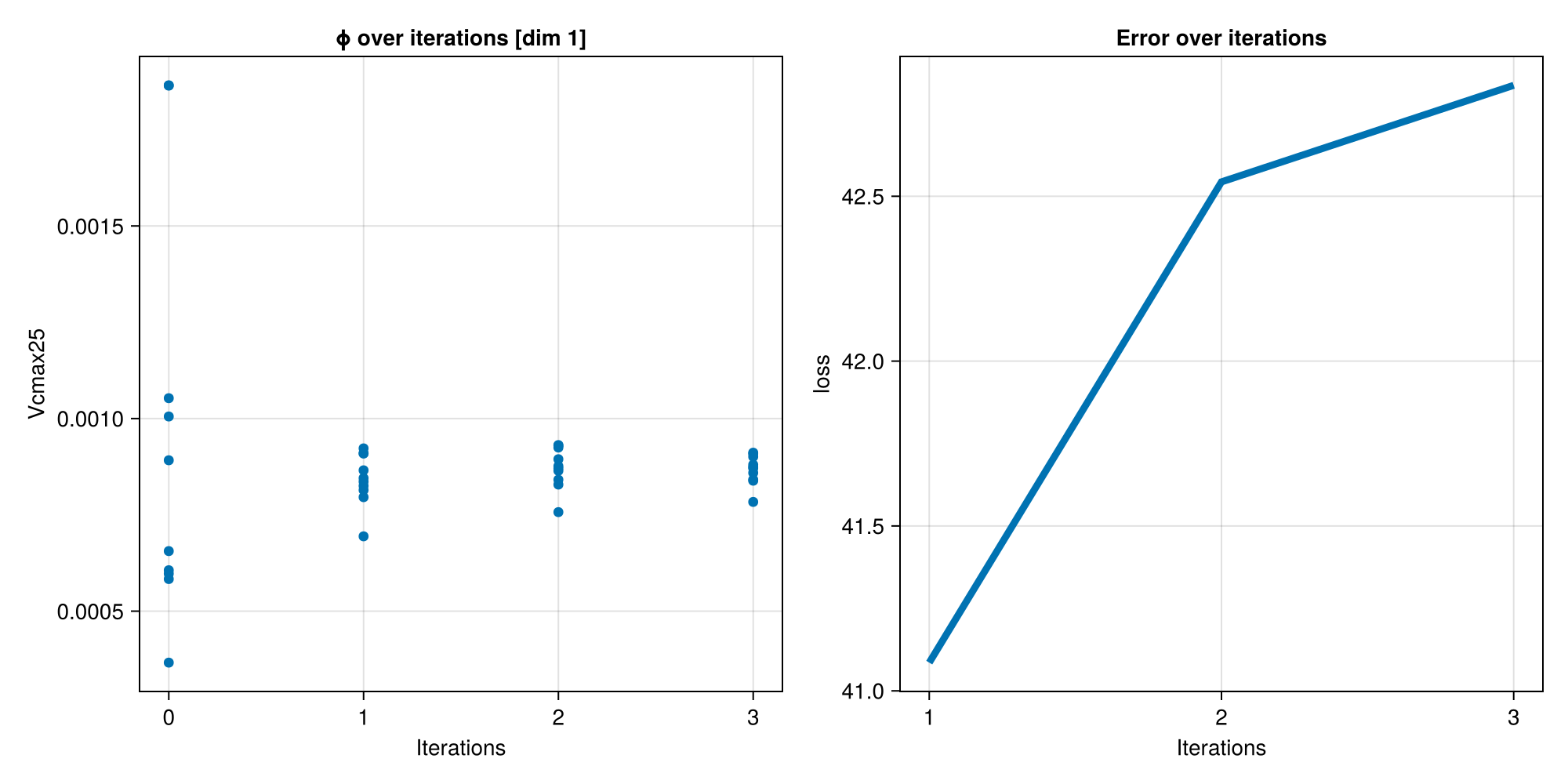
Compare the model output between the first and last iterations to assess improvement:
fig = CairoMakie.Figure(size = (900, 400))

first_G_ensemble = EKP.get_g(ensemble_kalman_process, 1)
last_iter = EKP.get_N_iterations(ensemble_kalman_process)
last_G_ensemble = EKP.get_g(ensemble_kalman_process, last_iter)
n_ens = EKP.get_N_ens(ensemble_kalman_process)

ax = Axis(
    fig[1, 1];
    title = "G ensemble: first vs last iteration (n = $(n_ens), iters 1 vs $(last_iter))",
    xlabel = "Observation index",
    ylabel = "G",
)
Makie.Axis with 0 plots:
Plot model output of first vs last iteration ensemble
for g in eachcol(first_G_ensemble)
    lines!(ax, 1:length(g), g; color = (:red, 0.6), linewidth = 1.5)
end

for g in eachcol(last_G_ensemble)
    lines!(ax, 1:length(g), g; color = (:blue, 0.6), linewidth = 1.5)
end

lines!(
    ax,
    1:length(observations),
    observations;
    color = (:black, 0.6),
    linewidth = 3,
)

axislegend(
    ax,
    [
        LineElement(color = :red, linewidth = 2),
        LineElement(color = :blue, linewidth = 2),
        LineElement(color = :black, linewidth = 4),
    ],
    ["First ensemble", "Last ensemble", "Observations"];
    position = :rb,
    framevisible = false,
)

CairoMakie.resize_to_layout!(fig)
CairoMakie.save("perfect_model_G_first_and_last.png", fig);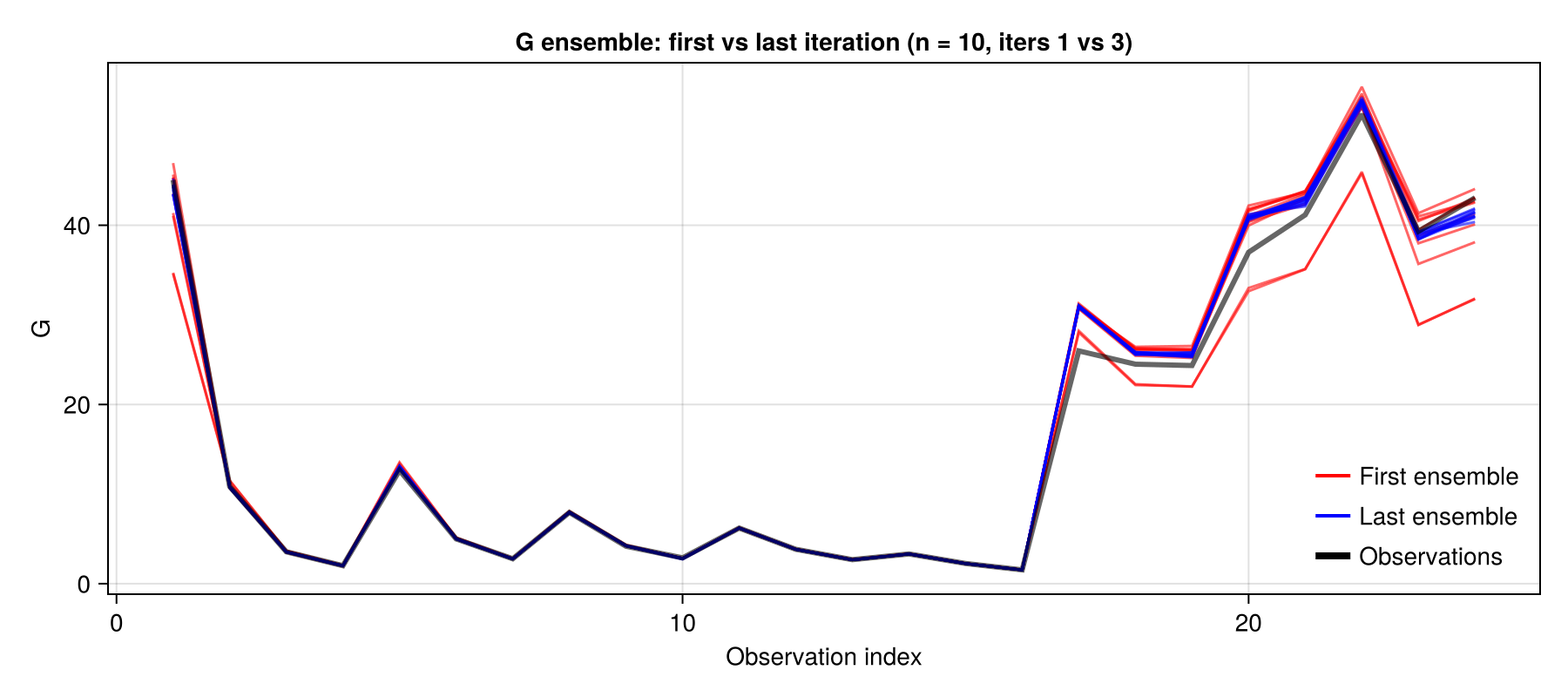
This page was generated using Literate.jl.