
Staggered grid
Velocities
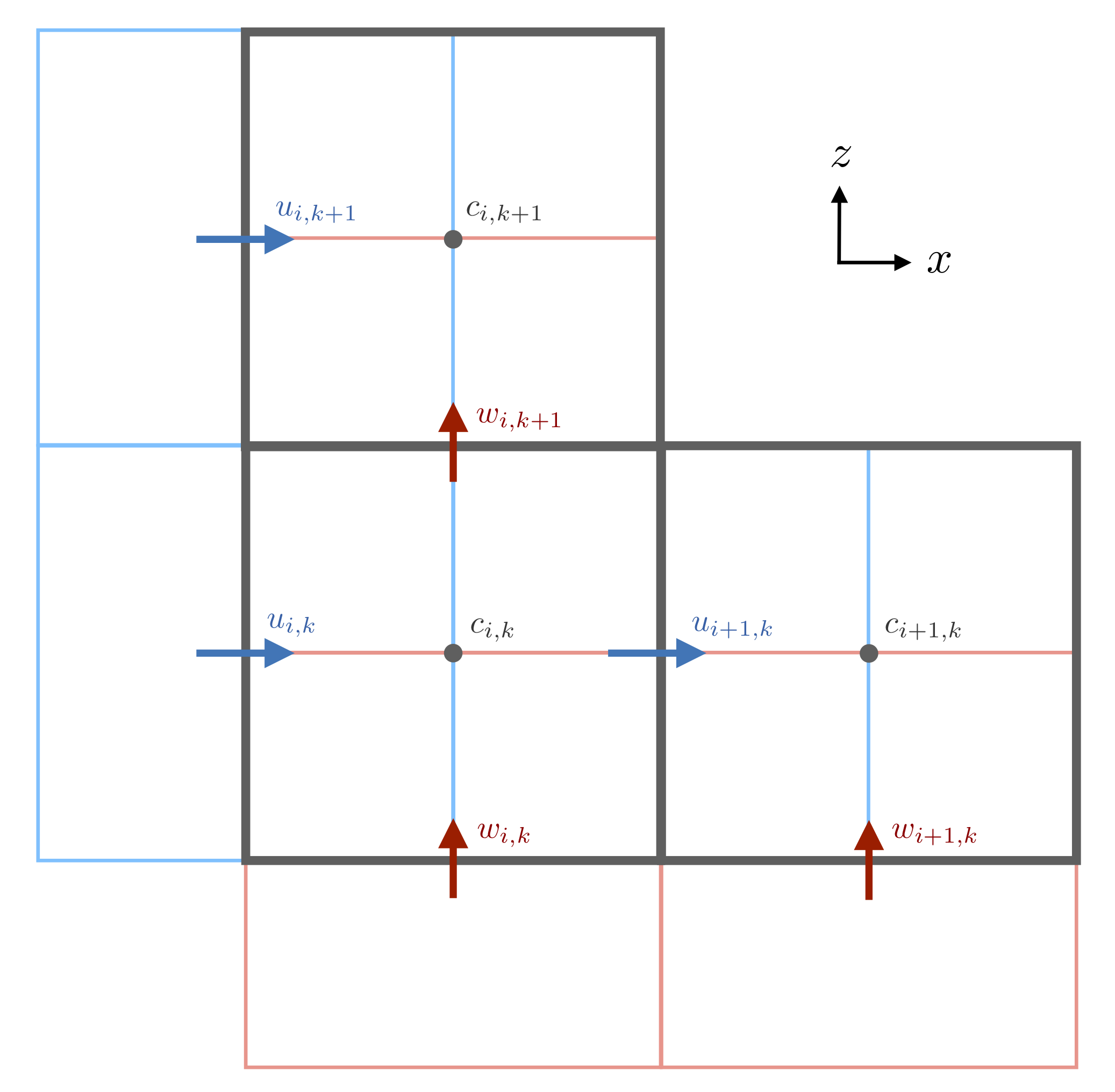 A schematic of
 Oceananigans.jl finite volumes for a two-dimensional staggered grid in
This staggered arrangement of variables is more complicated than the collocated grid arrangement but is greatly beneficial as it avoids the odd-even decoupling between the pressure and velocity if they are stored at the same positions. §6.1 of discusses this problem in the presence of a zigzag pressure field: on a 1D collocated grid the velocity at the point
From the viewpoint of linear algebra, these spurious pressure modes correspond to solutions in the null space of the pressure projection operator with eigenvalue zero and are thus indistinguishable from a uniform pressure field ().
The staggered grid was first introduced by with their marker and cell method. In meteorology and oceanography, this particular staggered grid configuration is referred to as the Arakawa C-grid after , who investigated four different staggered grids and the unstaggered A-grid for use in an atmospheric model.
investigated the dispersion relation of inertia-gravity waves[2] traveling in thein the linearized rotating shallow-water equations for five grids. Here
where
The B and C-grids are less oscillatory than the others and quite faithfully simulate geostrophic adjustment. However, the C-grid is the only one that faithfully reproduces the two-dimensional dispersion relation