
Implementing Turbulence Closures
This guide shows how to implement a turbulence closure in Oceananigans. We'll build PacanowskiPhilanderVerticalDiffusivity, a Richardson number-based mixing parameterization from .
The Pacanowski-Philander formulation computes eddy viscosity
where
Julia's multiple dispatch lets us implement this closure anywhere—a script, a package, or within Oceananigans itself—and it will integrate seamlessly with NonhydrostaticModel and HydrostaticFreeSurfaceModel.
Overview
Turbulence closures add diffusive fluxes to the momentum and tracer equations. The key components are:
Abstract types for dispatch
Diffusivity computation before each time step
Flux functions that use precomputed diffusivities
Time discretization (explicit or vertically implicit)
All closures inherit from AbstractTurbulenceClosure{TimeDiscretization, RequiredHalo}. For scalar diffusivities, we use AbstractScalarDiffusivity{TD, Formulation, RequiredHalo} where Formulation is VerticalFormulation, HorizontalFormulation, or ThreeDimensionalFormulation. See the Turbulence closures documentation for a list of built-in closures.
Step-by-step implementation
Step 1: Define the struct
The closure struct holds its parameters:
using Oceananigans.TurbulenceClosures: AbstractScalarDiffusivity, VerticalFormulation

struct PacanowskiPhilanderVerticalDiffusivity{TD, FT} <: AbstractScalarDiffusivity{TD, VerticalFormulation, 1}
    ν₀ :: FT  # Background viscosity
    ν₁ :: FT  # Shear-driven viscosity coefficient
    κ₀ :: FT  # Background diffusivity
    c  :: FT  # Richardson number scaling coefficient
    n  :: FT  # Exponent for viscosity
    maximum_diffusivity :: FT
    maximum_viscosity :: FT
end
Key points:
Type parameters:
TDis the time discretization,FTis the float typeSupertype:
AbstractScalarDiffusivity{TD, VerticalFormulation, 1}indicates:This closure uses scalar (not tensor) diffusivities
It only acts in the vertical direction (
VerticalFormulation)It requires a halo size of 1
All fields are concretely typed: This is essential for type stability and GPU performance
Step 2: Create the constructor
Provide a user-friendly constructor with sensible defaults:
using Oceananigans: VerticallyImplicitTimeDiscretization

function PacanowskiPhilanderVerticalDiffusivity(time_discretization = VerticallyImplicitTimeDiscretization(),
                                                FT = Float64;
                                                ν₀ = 1e-4, ν₁ = 1e-2, κ₀ = 1e-5,
                                                c  = 5.0, n  = 2.0,
                                                maximum_diffusivity = Inf,
                                                maximum_viscosity = Inf)

    TD = typeof(time_discretization)

    return PacanowskiPhilanderVerticalDiffusivity{TD, FT}(
        convert(FT, ν₀),
        convert(FT, ν₁),
        convert(FT, κ₀),
        convert(FT, c),
        convert(FT, n),
        convert(FT, maximum_diffusivity),
        convert(FT, maximum_viscosity))
end

# Test it works
PacanowskiPhilanderVerticalDiffusivity()
Main.PacanowskiPhilanderVerticalDiffusivity{VerticallyImplicitTimeDiscretization, Float64}(0.0001, 0.01, 1.0e-5, 5.0, 2.0, Inf, Inf)Important conventions:
The first positional argument is
time_discretizationThe second positional argument is the float type
FTAll physics parameters are keyword arguments
Always
converttoFTto ensure type consistency
Step 3: Define locations and accessors
Diffusivities live at specific grid locations. Vertical diffusivities that multiply vertical gradients belong at (Center, Center, Face). We also define accessors that extract the viscosity and diffusivity from the precomputed fields:
using Oceananigans.Grids: Center, Face
using Oceananigans.TurbulenceClosures

const PPVD = PacanowskiPhilanderVerticalDiffusivity

## Locations
@inline TurbulenceClosures.viscosity_location(::PPVD) = (Center(), Center(), Face())
@inline TurbulenceClosures.diffusivity_location(::PPVD) = (Center(), Center(), Face())

## Accessors (extract from precomputed fields)
@inline TurbulenceClosures.viscosity(::PPVD, diffusivities) = diffusivities.νz
@inline TurbulenceClosures.diffusivity(::PPVD, diffusivities, id) = diffusivities.κz
The id argument is the tracer index, useful for closures with tracer-specific diffusivities.
Step 4: Build closure fields
Closures that precompute diffusivities need storage Fields. Define build_closure_fields to create them:
using Oceananigans.Fields: Field

function TurbulenceClosures.build_closure_fields(grid, clock, tracer_names, bcs, closure::PPVD)
    κz = Field{Center, Center, Face}(grid)
    νz = Field{Center, Center, Face}(grid)
    return (; κz, νz)
end
The returned NamedTuple becomes model.closure_fields and is passed to compute_closure_fields! and flux functions.
Step 5: Implement diffusivity computation
The core of the closure is compute_closure_fields!, which updates diffusivity fields each time step. First, helper functions for the Richardson number:
using Oceananigans.BuoyancyFormulations: ∂z_b
using Oceananigans.Operators: ℑxᶜᵃᵃ, ℑyᵃᶜᵃ, ∂zᶠᶜᶠ, ∂zᶜᶠᶠ

## Square a function evaluation at a point
@inline ϕ²(i, j, k, grid, ϕ, args...) = ϕ(i, j, k, grid, args...)^2

## Compute vertical shear squared at (Center, Center, Face)
@inline function shear_squaredᶜᶜᶠ(i, j, k, grid, velocities)
    ∂z_u² = ℑxᶜᵃᵃ(i, j, k, grid, ϕ², ∂zᶠᶜᶠ, velocities.u)
    ∂z_v² = ℑyᵃᶜᵃ(i, j, k, grid, ϕ², ∂zᶜᶠᶠ, velocities.v)
    return ∂z_u² + ∂z_v²
end

## Compute Richardson number at (Center, Center, Face)
@inline function Riᶜᶜᶠ(i, j, k, grid, velocities, buoyancy, tracers)
    S² = shear_squaredᶜᶜᶠ(i, j, k, grid, velocities)
    N² = ∂z_b(i, j, k, grid, buoyancy, tracers)
    S²_min = eps(eltype(grid))
    Ri = max(zero(grid), N²) / max(S², S²_min)
    return Ri
end
Now the main function and GPU kernel:
using Oceananigans.Utils: launch!
using Oceananigans.TurbulenceClosures: buoyancy_tracers, buoyancy_force
using KernelAbstractions: @kernel, @index

function TurbulenceClosures.compute_closure_fields!(diffusivities, closure::PPVD, model; parameters = :xyz)
    arch = model.architecture
    grid = model.grid
    tracers = buoyancy_tracers(model)
    buoyancy = buoyancy_force(model)
    velocities = model.velocities

    launch!(arch, grid, parameters,
            compute_pp_diffusivities!, diffusivities, grid, closure, velocities, tracers, buoyancy)

    return nothing
end

@kernel function compute_pp_diffusivities!(diffusivities, grid, closure, velocities, tracers, buoyancy)
    i, j, k = @index(Global, NTuple)

    Ri = Riᶜᶜᶠ(i, j, k, grid, velocities, buoyancy, tracers)

    ## Extract parameters
    ν₀ = closure.ν₀
    ν₁ = closure.ν₁
    κ₀ = closure.κ₀
    c  = closure.c
    n  = closure.n

    ## Pacanowski-Philander formulas
    denominator = 1 + c * Ri
    νz = ν₀ + ν₁ / denominator^n
    κz = κ₀ + ν₁ / denominator^(n + 1)

    ## Apply maximum limits
    νz = min(νz, closure.maximum_viscosity)
    κz = min(κz, closure.maximum_diffusivity)

    @inbounds diffusivities.νz[i, j, k] = νz
    @inbounds diffusivities.κz[i, j, k] = κz
end
GPU compatibility rules for kernels:
Use
@kernelfrom KernelAbstractions.jlUse
@index(Global, NTuple)to get indicesUse
@inboundsfor array accessNever use
if/elsewith different types—useifelseinsteadNever throw errors—GPU kernels cannot print or throw
Avoid allocations
Step 6: Implement show methods
Good display methods help users understand their closures:
using Oceananigans.Utils: prettysummary

Base.summary(closure::PPVD{TD}) where TD =
    string("PacanowskiPhilanderVerticalDiffusivity{$TD}")

function Base.show(io::IO, closure::PPVD)
    print(io, summary(closure), ":\n")
    print(io, "├── ν₀: ", prettysummary(closure.ν₀), '\n')
    print(io, "├── ν₁: ", prettysummary(closure.ν₁), '\n')
    print(io, "├── κ₀: ", prettysummary(closure.κ₀), '\n')
    print(io, "├── c: ", prettysummary(closure.c), '\n')
    print(io, "└── n: ", prettysummary(closure.n))
end

# Test it
PacanowskiPhilanderVerticalDiffusivity()
PacanowskiPhilanderVerticalDiffusivity{VerticallyImplicitTimeDiscretization}:
├── ν₀: 0.0001
├── ν₁: 0.01
├── κ₀: 1.0e-5
├── c: 5.0
└── n: 2.0Simulating a wind-driven boundary layer
Let's test the closure by comparing it with CATKEVerticalDiffusivity and TKEDissipationVerticalDiffusivity in a wind-driven boundary layer simulation.
First, we set up the simulation parameters:
using Oceananigans
using Oceananigans.Units

Lz = 256       # Domain depth (m)
Nz = 64        # Vertical resolution
N² = 1e-5      # Background stratification (s⁻²)
τˣ = -1e-4     # Surface kinematic stress (m² s⁻²), i.e. wind stress / density
Jᵇ = 0         # Surface buoyancy flux (m² s⁻³)
f  = 1e-4      # Coriolis parameter (s⁻¹)

stop_time = 2days
We'll create a helper function to set up and run simulations:
function run_boundary_layer(closure; stop_time)
    grid = RectilinearGrid(size=Nz, z=(-Lz, 0), topology=(Flat, Flat, Bounded))

    u_bcs = FieldBoundaryConditions(top = FluxBoundaryCondition(τˣ))
    b_bcs = FieldBoundaryConditions(top = FluxBoundaryCondition(Jᵇ))

    model = HydrostaticFreeSurfaceModel(grid;
                                        closure,
                                        buoyancy = BuoyancyTracer(),
                                        tracers = :b,
                                        coriolis = FPlane(f=f),
                                        boundary_conditions = (u=u_bcs, b=b_bcs))

    set!(model, b = z -> N² * z)  # linear stratification

    simulation = Simulation(model; Δt=10minutes, stop_time)
    conjure_time_step_wizard!(simulation, cfl=0.5, max_Δt=10minutes)
    run!(simulation)

    return model
end
Run all three closures:
## Run with Pacanowski-Philander
pp_closure = PacanowskiPhilanderVerticalDiffusivity(ν₁=5e-3, c=5.0)
model_pp = run_boundary_layer(pp_closure; stop_time)

## Run with CATKE
catke_closure = CATKEVerticalDiffusivity()
model_catke = run_boundary_layer(catke_closure; stop_time)

## Run with TKE-Dissipation (k-ε style)
tked_closure = TKEDissipationVerticalDiffusivity()
model_tked = run_boundary_layer(tked_closure; stop_time)
[ Info: Initializing simulation...
[ Info: ... simulation initialization complete (783.056 ms)
[ Info: Executing initial time step...
[ Info: ... initial time step complete (1.057 seconds).
[ Info: Simulation is stopping after running for 1.845 seconds.
[ Info: Simulation time 2 days equals or exceeds stop time 2 days.
[ Info: Initializing simulation...
[ Info: ... simulation initialization complete (101.931 ms)
[ Info: Executing initial time step...
[ Info: ... initial time step complete (3.395 seconds).
[ Info: Simulation is stopping after running for 3.508 seconds.
[ Info: Simulation time 2 days equals or exceeds stop time 2 days.
[ Info: Initializing simulation...
[ Info: ... simulation initialization complete (325.611 ms)
[ Info: Executing initial time step...
[ Info: ... initial time step complete (4.578 seconds).
[ Info: Simulation is stopping after running for 4.924 seconds.
[ Info: Simulation time 2 days equals or exceeds stop time 2 days.Let's visualize the resulting boundary layer profiles:
using CairoMakie

fig = Figure(size=(1000, 400))

z_pp = znodes(model_pp.tracers.b)
z_catke = znodes(model_catke.tracers.b)
z_tked = znodes(model_tked.tracers.b)

## Buoyancy profiles
ax1 = Axis(fig[1, 1], xlabel="Buoyancy (m s⁻²)", ylabel="z (m)",
           title="Buoyancy profile")

lpp = lines!(ax1, interior(model_pp.tracers.b, 1, 1, :), z_pp,
             label="Pacanowski-Philander", linewidth=2)
lcatke = lines!(ax1, interior(model_catke.tracers.b, 1, 1, :), z_catke,
                label="CATKE", linewidth=2, linestyle=:dash)
ltked = lines!(ax1, interior(model_tked.tracers.b, 1, 1, :), z_tked,
               label="TKE-Dissipation", linewidth=2, linestyle=:dot)

## Velocity profiles
ax2 = Axis(fig[1, 2], xlabel="Velocity (m s⁻¹)", ylabel="z (m)",
           title="Zonal velocity")

lines!(ax2, interior(model_pp.velocities.u, 1, 1, :), z_pp,
       label="PP", linewidth=2)
lines!(ax2, interior(model_catke.velocities.u, 1, 1, :), z_catke,
       label="CATKE", linewidth=2, linestyle=:dash)
lines!(ax2, interior(model_tked.velocities.u, 1, 1, :), z_tked,
       label="TKE-ϵ", linewidth=2, linestyle=:dot)

## Diffusivity profiles
ax3 = Axis(fig[1, 3], xlabel="Diffusivity (m² s⁻¹)", ylabel="z (m)",
           title="Tracer diffusivity", xscale=log10)

z_face_pp = znodes(model_pp.closure_fields.κz)
κ_pp = interior(model_pp.closure_fields.κz, 1, 1, :)
κ_pp_plot = max.(κ_pp, 1e-6)  ## Avoid log of zero
lines!(ax3, κ_pp_plot, z_face_pp, label="PP", linewidth=2)

z_face_catke = znodes(model_catke.closure_fields.κc)
κ_catke = interior(model_catke.closure_fields.κc, 1, 1, :)
κ_catke_plot = max.(κ_catke, 1e-6)
lines!(ax3, κ_catke_plot, z_face_catke, label="CATKE", linewidth=2, linestyle=:dash)

z_face_tked = znodes(model_tked.closure_fields.κu)
κ_tked = interior(model_tked.closure_fields.κu, 1, 1, :)
κ_tked_plot = max.(κ_tked, 1e-6)
lines!(ax3, κ_tked_plot, z_face_tked, label="TKE-ε", linewidth=2, linestyle=:dot)

fig[2, :] = Legend(fig, [lpp, lcatke, ltked], ["Pacanowski-Philander", "CATKE", "TKE-ε"],
                   orientation = :horizontal, tellwidth = false, framevisible = false)

rowsize!(fig.layout, 2, Auto(0.15))  # adjust legend row height
rowgap!(fig.layout, 10)

fig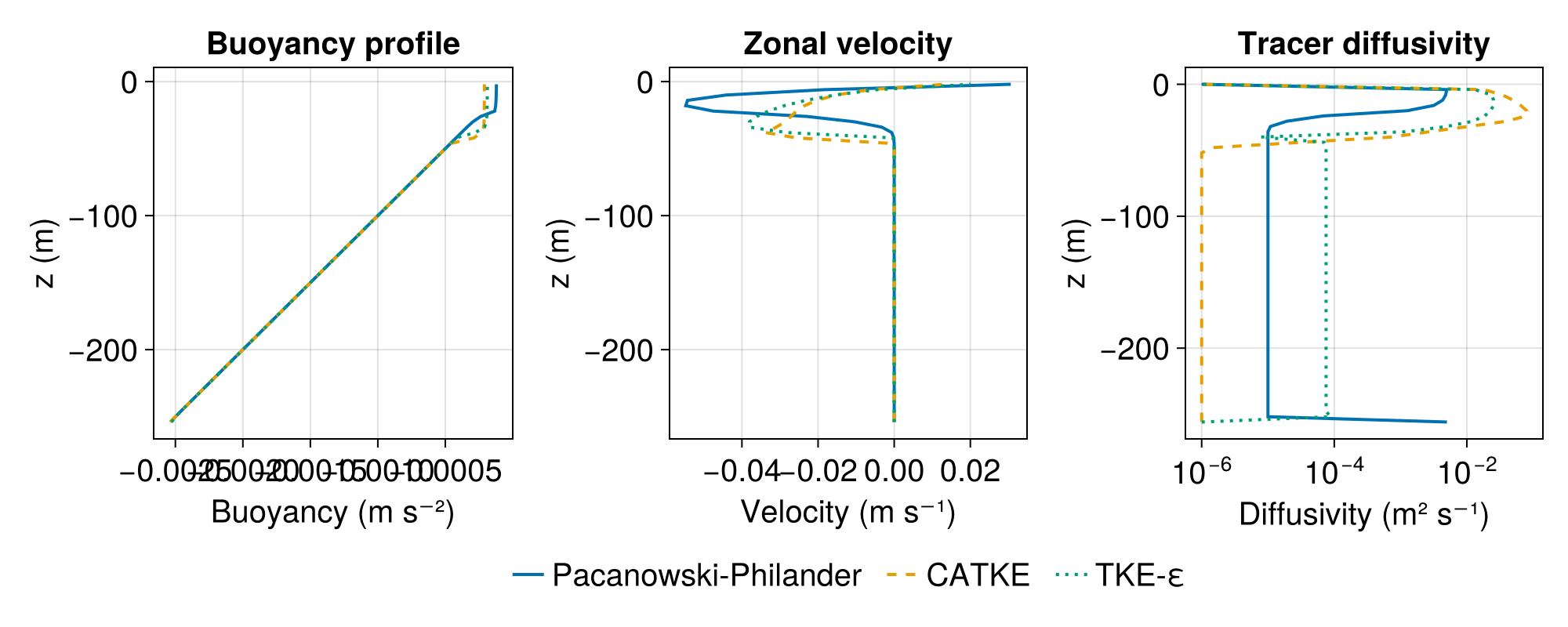
The comparison reveals differences in how the closures parameterize mixing:
Pacanowski-Philander uses a local Richardson number formulation, producing smooth diffusivity profiles that respond directly to the local shear and stratification
CATKEVerticalDiffusivityuses a prognostic TKE equation that captures non-local effects and produces sharper transitions at the boundary layer baseTKEDissipationVerticalDiffusivity(k-ε) uses two prognostic equations (for TKE and dissipation rate) allowing independent control of mixing length scales
How diffusivities become fluxes
compute_closure_fields!is called duringupdate_state!Precomputed diffusivities are stored in
model.closure_fieldsDuring tendency computation, flux functions (
diffusive_flux_z,viscous_flux_uz, etc.) use theviscosity()anddiffusivity()accessors
For AbstractScalarDiffusivity, flux functions are already implemented—you don't need to write them.
Time discretization
Two options for diffusive terms:
ExplicitTimeDiscretization — simple but has a diffusive CFL constraint:
using Oceananigans.TurbulenceClosures: ExplicitTimeDiscretization

closure = PacanowskiPhilanderVerticalDiffusivity(ExplicitTimeDiscretization())
PacanowskiPhilanderVerticalDiffusivity{ExplicitTimeDiscretization}:
├── ν₀: 0.0001
├── ν₁: 0.01
├── κ₀: 1.0e-5
├── c: 5.0
└── n: 2.0VerticallyImplicitTimeDiscretization (default) — stable for large diffusivities, uses a tridiagonal solver:
closure = PacanowskiPhilanderVerticalDiffusivity(VerticallyImplicitTimeDiscretization())PacanowskiPhilanderVerticalDiffusivity{VerticallyImplicitTimeDiscretization}:
├── ν₀: 0.0001
├── ν₁: 0.01
├── κ₀: 1.0e-5
├── c: 5.0
└── n: 2.0Advanced features
Closures that require extra tracers
Some closures (like CATKEVerticalDiffusivity) require prognostic equations for additional quantities (like TKE). Implement:
closure_required_tracers(::MyClosure) = (:e,) # requires tracer named :eClosures that modify boundary conditions
Some closures need special boundary conditions. Implement:
add_closure_specific_boundary_conditions(closure::MyClosure, bcs, args...) = modified_bcsCustom flux functions
For non-standard flux formulations (like tensor diffusivities for isopycnal mixing), you can override the flux functions directly. See IsopycnalSkewSymmetricDiffusivity for an example.
Testing
Create tests that verify:
Construction: The closure constructs with default and custom parameters
Type stability: Use
@code_warntypeon critical functionsGPU compatibility: Run on GPU to catch dynamic dispatch issues
Physical behavior: Test that diffusivities respond correctly to flow conditions
Conservation: Verify that the closure doesn't create or destroy tracer mass
Example test:
using Test

closure = PacanowskiPhilanderVerticalDiffusivity()
grid = RectilinearGrid(size=(4, 4, 4), extent=(1, 1, 1))
model = NonhydrostaticModel(grid; closure=closure, buoyancy=BuoyancyTracer(), tracers=:b)

@test model isa NonhydrostaticModel

time_step!(model, 1)
@test model.clock.time == 1
Test PassedContributing your closure to Oceananigans
The closure we implemented above works immediately—you can use it in any script or package. Julia's multiple dispatch means the methods we defined integrate seamlessly with Oceananigans without modifying the source code.
If you'd like to contribute your closure to Oceananigans itself, here are the additional steps:
1. Create a source file
Place your implementation in a file under src/TurbulenceClosures/turbulence_closure_implementations/. For example:
src/TurbulenceClosures/turbulence_closure_implementations/pacanowski_philander_vertical_diffusivity.jl2. Include the file
Add an include statement in src/TurbulenceClosures/TurbulenceClosures.jl:
include("turbulence_closure_implementations/pacanowski_philander_vertical_diffusivity.jl")3. Export the closure
Add the closure to the exports in TurbulenceClosures.jl:
export PacanowskiPhilanderVerticalDiffusivityAnd if it should be part of the top-level public API, also export it from src/Oceananigans.jl.
4. Add documentation
Add a docstring to the constructor
Add an entry to the Turbulence closures documentation page
Add any references to
docs/oceananigans.bib
5. Write tests
Add tests to the test suite in test/ following existing patterns.
6. Open a pull request
Follow the Contributors Guide to submit your implementation for review.
Summary
To implement a turbulence closure:
Define a struct inheriting from an appropriate abstract type
Create a constructor with sensible defaults
Specify locations and accessors for viscosity/diffusivity
Build fields with
build_closure_fieldsCompute closure fields with
compute_closure_fields!Add display methods with
summaryandshow
That's it! Your closure is ready to use. Contributing to Oceananigans is optional but helps the community benefit from your work.